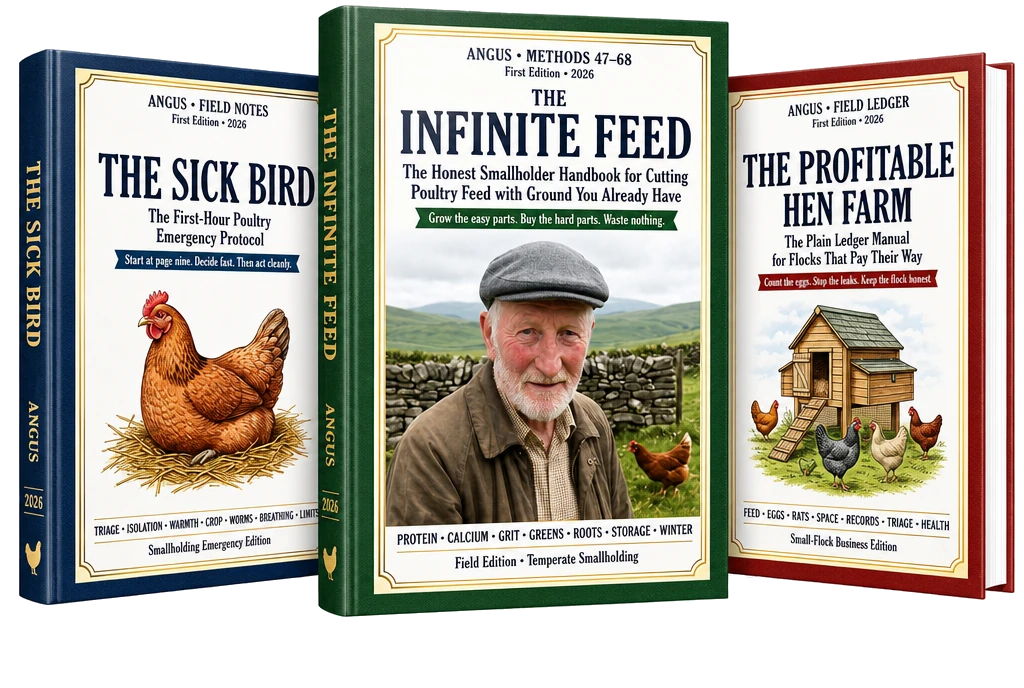


Fifth generation Highland crofter. Thirty years a livestock vet.
A bird hides illness until she cannot. By the time she is standing still with her feathers up, you are not at the start of the problem. You are near the end of it.
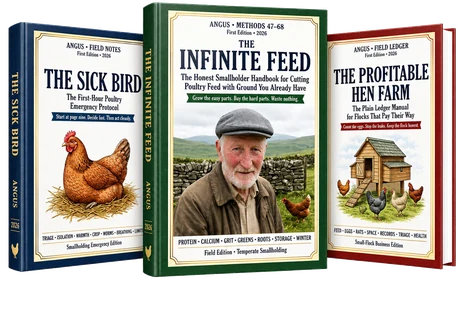
Three books. What the bird is telling you and what to do about it before you phone anyone. What a flock actually costs to keep, in numbers you work out yourself. And how to grow most of the feed so you stop buying it.
No theory. I have been on both sides of the gate ... the one paying for the feed, and the one arriving in the van to charge you.
Get the set ... $47Three books. Instant download. Read on a phone, standing in the coop, with cold hands.
A hen is a prey animal. Everything about her is built to hide weakness, because in the wild the one that looks ill is the one that gets taken. She will keep eating when she feels rotten. She will keep up with the others when she wants to sit down. She will do this for days.
So she does not show you the start of the illness. She shows you the end of it.
By the time she is standing apart from the flock, tail down, feathers lifted, eyes half shut, the thing that is wrong has usually been wrong for the better part of a week. What you are looking at is not the first symptom. It is the last one she can hide.
That is why the window is short.
A bird that is off her feet and going cold is running on almost nothing. She has no fat to spare and a body temperature that drops fast once she stops moving. Coccidiosis, egg binding, sour crop, a heavy worm burden, a respiratory infection that has gone down into the air sacs ... every one of those has a point where a person standing there with warm hands and ten minutes can still turn it. And a point, not long after, where nobody can.
The difference between those two points is usually the same thing. Whether the person standing there knew what to check, and in what order.
You do not need to know what she has. You need to know what to do in the next ten minutes while you work it out.
That is the whole reason the second book exists. And it is why page nine is where it starts, not page ninety.
Angus Douglas. Fifth generation on the same croft, north west Highlands, where the wind comes off the water and nothing grows that has not been argued with.
I qualified as a livestock vet and I came back. Thirty years in a van on single track roads, mostly cattle and sheep, and a great deal of poultry that nobody was supposed to be phoning a vet about.
That last part is the bit worth understanding.
Nobody calls a vet for a hen. The bird is worth less than the callout and everybody in the transaction knows it. So the hen gets left. She gets left through the day she goes quiet, and the night she does not come in, and by the time the phone rings it is Sunday and there are four more of them off their feet and now it is not a hen, it is the flock.
I have driven out to a lot of those. Most of them did not need me.
Most of what I got called out for, the crofter could have fixed before I arrived. I know, because I charged them anyway.
That is not a confession. It is the job. I did the work and I sent the bill and the bill was fair for my time.
But I drove home from enough of them thinking the same thing. That was twenty minutes and a bit of knowing what to look at. She had the bird. She had the time. She did not have the twenty minutes of knowing.
So that is what these are. The twenty minutes of knowing, written down.
And I will tell you the other half of it, because a man who says he can save every bird is selling you something. Some of them are past it. Some of them need a vet, and some of them need a vet today, not tomorrow. The second book tells you which is which, plainly, and it tells you when to stop trying and pick up the phone. I would rather you spent the callout on the bird that could be saved than on the four that could have been.
Book one
From a few hens to a business that pays.
Most people keeping hens have no idea whether the birds cost them money or make them money. They know what a bag of feed costs. They do not know what an egg costs. Those are different questions and only one of them is useful.
This book gives you the arithmetic. Not my numbers ... yours. Your feed price, your water, your ground, your winter. You put your own figures in and the sums tell you where you actually stand. Some people run it and find they are doing better than they thought. Some run it and find the flock has been quietly eating the housekeeping for two years.
Both of those are worth knowing. Only one of them is comfortable.
It does not tell you what you will earn. It does not print a figure and call it a month. I do not know your feed price, your ground or how hard you work, so anyone who hands you a number has invented it. What you get is the workings. You put your own numbers in and read what comes out. That is the only honest way to do this.
Book two
What to do in the first ten minutes.
This is the one you will use at seven in the morning in your dressing gown with a torch.
It is built for the moment, not for the study. Every chapter starts with the thing you can see ... she is not eating, she is straining, there is blood in the droppings, she is making a noise when she breathes ... and takes you from that to what you do next, in order, with your hands. No Latin until you need it. No diagnosis before the bird is warm.
I wrote it the way I would talk you through it on the phone at a quarter past six on a Sunday. Which I have done, more times than I can count, usually for nothing.
Not the introduction, not my life story, not a chapter on the history of the domestic fowl. Page nine, straight in. If a bird is bad while you are reading this, that is where you go and everything else can wait.
I would rather you never opened it. But you will, and it will be dark and cold and you will be on your own, and it will be open on the floor beside you. That is what it is for.
Book three
Growing what they eat, so you stop buying it.
The feed bag is the reason most flocks do not pay.
Everything else is one off. The coop is built, the fencing is up, the birds are bought. The bag comes back every fortnight for as long as you keep hens, and it goes up every year, and it is the single line in the sums from book one that decides whether the whole thing works.
So this book is about taking that line down. Not to nothing ... I will come to that ... but a long way down, using ground you already have and work you are already doing.
Anyone who tells you they feed a laying flock on nothing through a Highland winter is either lying or keeping three hens as pets. Layers need protein and calcium at a level the ground will not give you in the dark months. What you can do is take the bag from every fortnight to occasionally, and know exactly what you still have to buy and why. That is the honest version, and it is still the difference between a flock that pays and one that does not.
There is a kind of person these are written for. If that is not you, close the page. I am not going to talk you round.
This is for you if
This is not for you if
If you read the right hand column and thought that is fine, that is me, then it is me you were written for and you already know it.
These went on sale recently and I am not going to invent a wall of them. What I have instead is thirty years of driving out to birds that did not need me. The video I put up about bringing a dying hen round has been watched 62,000 times, and the comments under it are people describing the same symptoms back to me, over and over ... that does not tell you the books work, it tells you the questions are real and that a great many people are standing in a coop with nobody to ask. If you buy it and it is no use to you, take your money back and think no worse of me.
I will not tell you what a vet charges where you live. It varies enormously and anybody who quotes you a figure has guessed. You know roughly what a visit runs to in your part of the world. This sits under it, and in most places it sits well under it.
The price is the smaller half of the argument though. What matters is what you are left holding afterwards.
A callout ends. The van goes back down the road and takes everything the man knows with it, and when the next bird goes down on the next Sunday you are standing exactly where you stood before, with the same phone in your hand. You paid to have one bird seen, one time.
This does not end. It works on the bird that is bad tonight, and on every bird you keep for the rest of your life, and on the ones your neighbour brings round because word gets about.
Three books. $47 for the set.
One payment. No subscription, no second half of the book behind another door, no upgrade you find out about in a month. You buy it, you download it, it is yours, and you will not hear from me about money again unless you want to.
Set it against what a point of lay pullet costs to replace, and the arithmetic does its own arguing. I am not going to do it for you here.
Get the set ... $47Instant download. Readable on a phone. If it is no use to you, ask and you get your money back.
Thirty days. You email and say it was not what you wanted, and you get your money back. No form, no questionnaire, no three reasons why. Keep the files, I am not going to chase you for them.
I am not being generous. I would rather return $47 than have somebody out there who thinks I sold them something.
One thing though, and I will be straight about it. A refund does not bring a bird back. That is the argument for reading it now, on a quiet evening, rather than at ten past six on a Sunday with the torch in your teeth.
Three PDFs. Read them on a phone, a tablet, a computer, or print them. No app, no login, no course platform, nothing that can stop working.
Straight away. The download appears the moment you have paid, and it goes to your email as well in case you close the page.
The Sick Bird is the same book whether you have four or four hundred, because a sick hen is a sick hen. The Profitable Hen Farm scales down honestly and will tell you plainly if four birds are never going to pay for themselves. Most people with four are not trying to make money anyway. They are trying not to lose the bird.
The sick bird work is not basic, it is fast, which is different. The feed book is where a bigger flock gets its money back, because you are buying the most bags.
The bird does not know where she is. Anatomy, symptoms and what to do in the first ten minutes are the same everywhere. Weather and rules are not, so where local regulation matters I tell you that it exists and how to check it rather than pretending my rules are yours.
No, and it says so repeatedly. It is what to do in the ten minutes before you decide whether you need one, and it is honest about the point where the answer is yes, today.
No. They are made to be read on a screen, and The Sick Bird is laid out for a phone held in one hand. Print them if you would rather have paper in the coop, but nothing depends on it.
No. They are one set at one price and it is cheaper than any two of them would be separately.
It will be a Sunday, or the day you are leaving, or the coldest week of the year. You will go out and one of them will be standing apart from the others with her feathers up and you will have about ten minutes.
You will either know what to check, or you will be looking it up on a phone with one bar of signal.
Instant download. Thirty days to change your mind.
Buy it tonight and read page nine before the bed. Then hope you never need it.